Insulating Older Irish Homes: A Practical Guide by Era
Why Older Homes Need a Different Approach
Insulating a house built in the 1960s is a very different job to insulating one built in the 1860s. Older homes have different wall types, different moisture behaviour, and different structural constraints. What works brilliantly on a 1980s estate house can cause serious problems on a stone cottage.
This guide breaks it down by era so you can understand what approach suits your home and avoid the mistakes that make things worse.
Pre-1940: Stone and Solid Brick Houses
What you’re dealing with
These are Ireland’s most challenging homes to insulate. Walls are solid stone (often 400mm to 600mm thick), solid brick, or a mix of both. There is no cavity. The walls were designed to breathe, managing moisture by absorbing it and letting it evaporate. Many have lime mortar rather than cement.
Common examples: period townhouses, farmhouses, stone cottages, Georgian and Victorian terraces.
What works
External wall insulation (with breathable materials). This is usually the best option for solid stone walls. The critical point is using a breathable insulation system. Wood fibre boards or mineral wool, finished with a lime-based or silicone render, allow moisture to pass through the wall as it always has. Standard EPS (polystyrene) with cement render can trap moisture in the stonework, leading to damp and decay.
Internal dry lining (with care). If external insulation isn’t possible (listed building, conservation area, or the owner wants to keep the stone exterior), internal insulation can work. But it must be designed to manage moisture. A vapour-open system with calcium silicate boards or wood fibre is safer than standard plasterboard and PIR foam, which can trap moisture against the old wall.
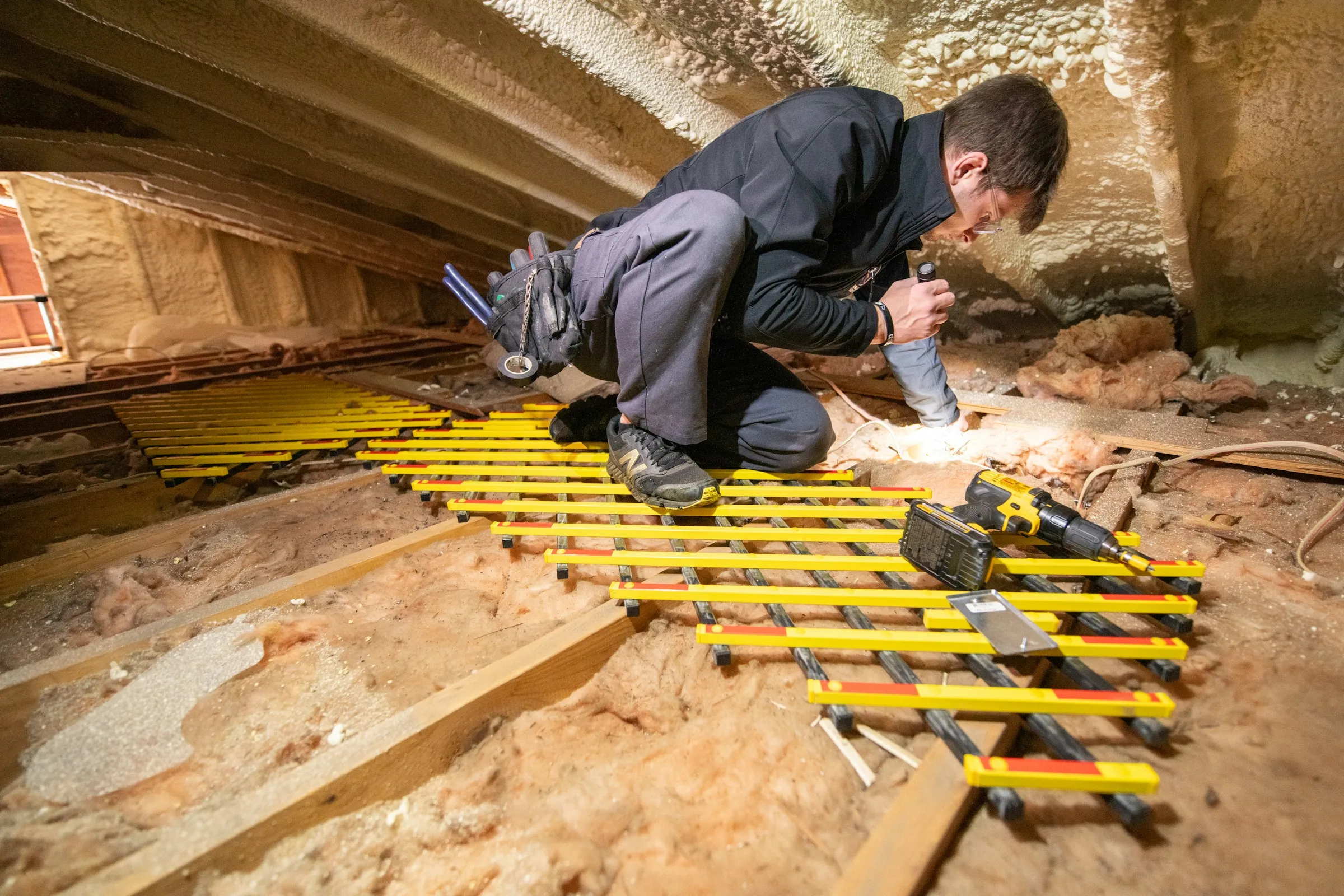
Attic insulation. This is straightforward on most older homes and should be done first. Mineral wool between and over the joists is the standard approach. Make sure the eaves are ventilated to prevent condensation in the roof space.
What to avoid
- Spray foam on stone walls. Closed cell spray foam on the interior of solid stone walls traps moisture. The wall can no longer breathe, and damp problems often follow within a few years.
- Standard EPS external insulation. Unless the render system is breathable, this can trap moisture in the wall.
- Cement-based render over lime mortar. Cement is harder and less permeable than lime. It traps moisture and can cause the stone to deteriorate. Always use lime-based products on lime mortar walls.
- Filling gaps in stonework with expanding foam. This looks tempting but prevents the wall from doing what it’s designed to do.
Grants
Homes built before 1940 are eligible for SEAI individual grants provided they were occupied before 31 December 2010. The Warmer Homes Scheme covers homes built before 2006, but stone/period homes built before 1940 are generally ineligible for wall insulation under that scheme (attic insulation may still be covered).
External wall insulation grants: up to €6,000 for a semi-detached, up to €8,000 for a detached house. See our SEAI grants guide for full details.
1940s to 1970s: Early Cavity and Solid Block
What you’re dealing with
This era is mixed. Some houses have solid concrete block walls. Others have early cavity walls with a narrow gap (sometimes only 25mm to 50mm). Many have no insulation at all. The quality of construction varies widely, from well-built local authority housing to more basic rural builds.
Common examples: local authority housing schemes, suburban semi-detached estates, bungalows.
What works
Cavity wall injection (if cavities exist and are wide enough). Many homes from this era have cavities of 50mm or more, which can be filled with bonded bead or mineral wool. An installer can check the cavity width by drilling a small test hole. This is the quickest and cheapest option where it’s available.
External wall insulation. For homes with solid walls or very narrow cavities that can’t be filled, EWI is the main option. Standard systems work well on concrete block walls because moisture management is less critical than with stone.
Attic insulation. Most homes from this era have either no attic insulation or a thin layer that’s well below current standards. Topping up or replacing it is a priority.
What to watch for
- Narrow cavities. Some 1950s and 1960s homes have cavities of only 25mm to 40mm. These may not be suitable for standard injection. A specialist can advise whether a thin cavity can be foam-injected or whether external insulation is the better route.
- Rubble in cavities. Older cavity walls sometimes have mortar droppings or rubble at the bottom of the cavity, which can obstruct fill material. A good installer will check for this before proceeding.
- Flat roofs. Some 1960s and 1970s extensions have flat roofs with minimal insulation. These are often the coldest part of the house and should be addressed.
For cavity wall costs and details, see our cavity wall insulation cost guide.
1980s to 2000s: Modern Cavity Walls
What you’re dealing with
Most homes built from the 1980s onwards have standard cavity walls with a gap of 50mm to 100mm. Building regulations started requiring insulation from the mid-1990s, so homes built after this may already have partial cavity fill from original construction. Pre-1990s homes from this era usually have unfilled cavities.
Common examples: housing estates, suburban semis and detacheds, apartment blocks.
What works
Cavity wall injection. This is the go-to for most homes from this era. If the cavities are unfilled, getting them filled is cheap, quick, and effective. Bonded bead is the most common material.
Attic top-up. Homes from the 1980s and early 1990s often have some attic insulation but not to current standards (which specify 300mm of mineral wool or equivalent). Topping up the existing insulation is straightforward and inexpensive.
External wall insulation. Less commonly needed for this era, but worth considering if you’re doing a deeper retrofit to hit a high BER target. Some homeowners choose EWI when the exterior render needs replacing anyway, getting insulation and a new finish in one project.
What to watch for
- Partial cavity fill. Some 1990s homes have insulation in part of the cavity but not all. An installer can check whether there are gaps or sections that were missed during original construction.
- Timber frame. Some homes from the 1990s onwards are timber frame rather than block and block. These have insulation between the studs and don’t need (and can’t have) cavity injection. If you’re unsure whether your home is timber frame, check the original building documentation or ask an installer.
The Breathability Question
Breathability is the most important concept when insulating older homes, and the most misunderstood. Here’s the short version:
Older walls (especially stone and lime mortar) manage moisture by allowing it to pass through the wall in both directions. They absorb moisture when it’s wet and release it when it dries. If you seal them up with a non-breathable insulation system, the moisture has nowhere to go. It gets trapped inside the wall, leading to damp, mould, and potentially structural damage.
Modern cavity walls and concrete block walls are less sensitive. They’re designed to manage moisture with a damp-proof course and cavity drainage, not by breathing. Standard insulation materials work fine on these.
The rule of thumb: if your home has solid stone or solid brick walls with lime mortar, insist on breathable materials and a contractor experienced with older buildings. If it has concrete block cavity walls from the 1950s or later, standard materials are fine.
For more on moisture management after insulating, see our insulation and ventilation guide.
How to Find the Right Insulation for Your Home’s Age
| Era | Wall Type | Best Insulation Option | Typical Cost (semi-d, after grant) |
|---|---|---|---|
| Pre-1940 | Solid stone/brick | Breathable EWI or internal dry lining | €12,000 - €22,000 |
| 1940s-1970s | Solid block or narrow cavity | Cavity fill (if possible) or EWI | €0 - €1,200 (cavity) / €12,000+ (EWI) |
| 1980s-2000s | Standard cavity | Cavity wall injection | €0 - €1,200 |
| All eras | Attic | Mineral wool or spray foam | €0 - €800 |
For a full comparison of all insulation types and costs, see our home insulation cost guide.
Frequently Asked Questions
Can I insulate a protected structure?
Yes, but with restrictions. You’ll likely need planning permission for any external changes. Internal insulation is usually the better route for listed buildings. Use conservation-grade materials (lime plaster, wood fibre, calcium silicate) and work with a contractor experienced with heritage buildings.
Is it worth insulating a house I might demolish and rebuild?
If you’re seriously considering demolishing, probably not. But if the rebuild is years away, even basic measures like attic insulation and draught proofing can make the house more comfortable and cheaper to heat in the meantime.
My 1960s house has damp. Should I insulate first or fix the damp?
Fix the damp first. Always. Insulating over a damp problem traps the moisture and makes it worse. Find the source (rising damp, penetrating damp, condensation) and address it. Then insulate.
Do older homes qualify for SEAI grants?
Yes, provided they were built and occupied before 31 December 2010. The Warmer Homes Scheme has a stricter cutoff of before 2006 but offers free upgrades to qualifying welfare recipients.
How do I find out what type of walls my home has?
A wall thickness of 270mm to 300mm usually indicates a cavity wall. Solid walls are typically around 225mm (brick) or thicker (stone). An insulation contractor can confirm the wall type and cavity width with a simple test drill. If you have the original building plans, they’ll show the wall construction clearly.