How Insulation Affects Your BER Rating (and Why It Matters)
What Is a BER Rating?
A Building Energy Rating (BER) measures how energy efficient your home is on a scale from A1 (most efficient) to G (least efficient). Think of it like the energy labels on a fridge or washing machine, but for your entire house. Every home sold or rented in Ireland since 2009 needs a valid BER certificate.
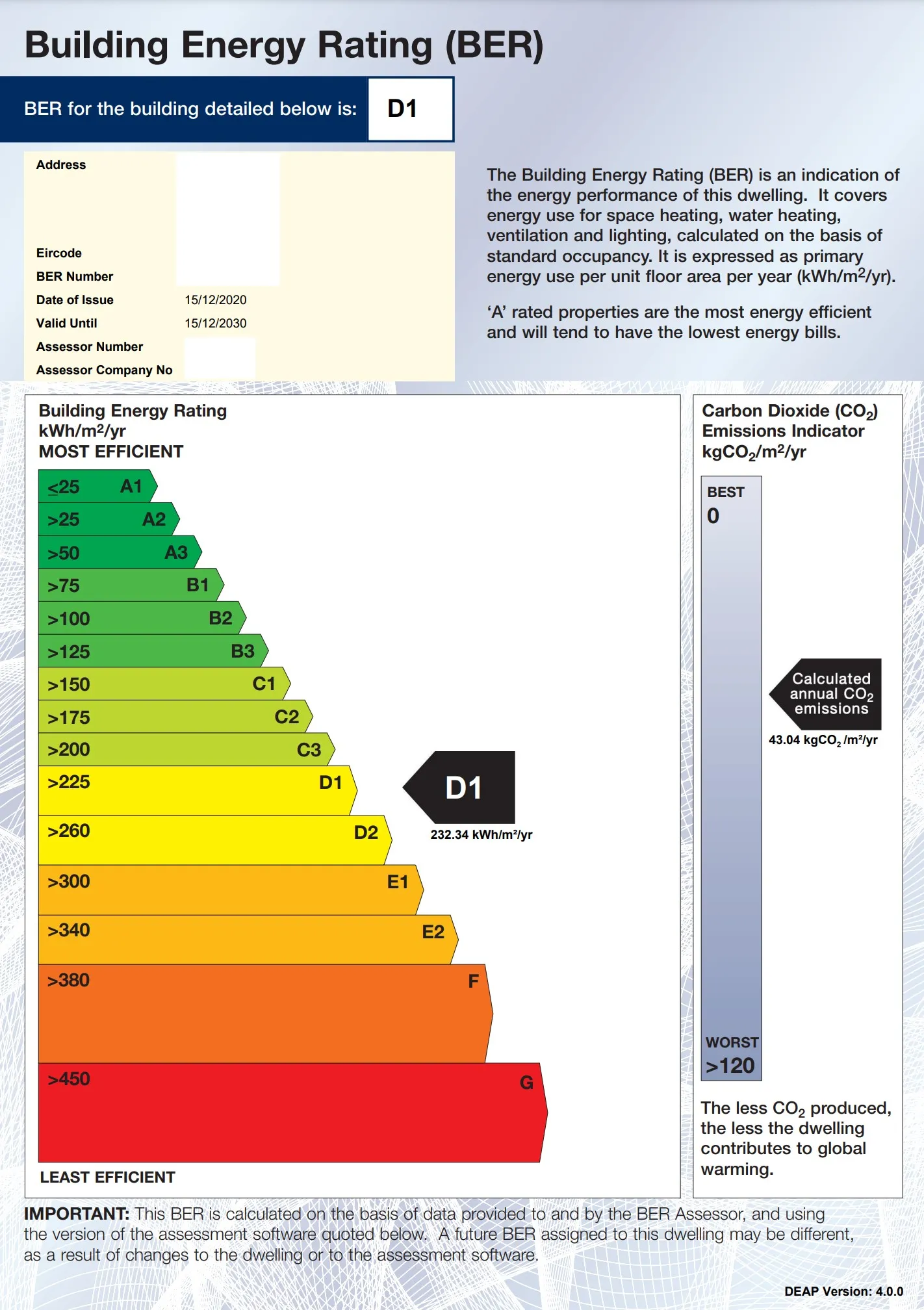
The rating is calculated by a BER assessor based on the building’s construction, insulation levels, heating system, ventilation, and other factors. It’s a theoretical calculation of how much energy your home needs per square metre per year, not a measurement of actual usage.
Why Your BER Rating Matters
Property value
Research from the ESRI and CSO shows that BER ratings have a real impact on property prices. Homes with a B rating sell for roughly 5% to 10% more than equivalent homes rated D or E. As energy awareness grows and energy costs stay high, this premium is increasing.
Energy costs
A home rated D typically costs €2,000 to €3,000 per year to heat. A B-rated home of the same size might cost €800 to €1,200. That’s a difference of over €1,000 per year. Over a decade, the savings are substantial.
Comfort
A better BER usually means a warmer, more comfortable home. Higher insulation levels and better airtightness mean fewer draughts, fewer cold spots, and more consistent temperatures.
Grant eligibility
Some SEAI grant routes require specific BER targets. The One Stop Shop scheme requires you to achieve a BER of B2 or better to qualify for the enhanced grant support.
Regulations
If you’re renting out a property, there’s growing pressure on minimum BER standards for rental homes. While a specific minimum hasn’t been legislated yet, it’s widely expected to come. Getting ahead of that makes sense.
How Much Does Each Insulation Type Improve Your BER?
The BER improvement depends on your starting point and what’s already in place. These are typical improvements for an average semi-detached house going from no insulation (or poor existing insulation) to current standards:
| Insulation Measure | Typical BER Improvement | Cost After SEAI Grant |
|---|---|---|
| Attic insulation | 1 - 2 grades | €0 - €800 |
| Cavity wall injection | 1 - 2 grades | €0 - €1,200 |
| External wall insulation | 2 - 3 grades | €12,000 - €20,000 |
| Internal dry lining | 1.5 - 2.5 grades | €1,500 - €6,500 |
| Floor insulation | 0.5 - 1 grade | €600 - €1,100 |
These are cumulative to a point. Insulating the attic and walls together delivers a bigger improvement than either alone. But there are diminishing returns. Once you’ve addressed the major heat loss areas, additional measures produce smaller BER jumps.
For detailed costs of each type, see our home insulation cost guide.
BER Before and After: Real Scenarios
Scenario 1: 1970s semi-detached, no insulation
Starting BER: E1 (typical for an uninsulated 1970s house)
| Upgrade | New BER |
|---|---|
| + Attic insulation | D1 |
| + Cavity wall fill | C2 |
| + New condensing boiler | C1 |
| + External wall insulation | B3 |
Total insulation cost (after grants): roughly €13,000 to €22,000. The biggest BER jumps come from the first measures (attic and cavity wall), which are also the cheapest.
Scenario 2: 1990s semi-detached, partial insulation
Starting BER: D1 (has some attic insulation, no wall insulation)
| Upgrade | New BER |
|---|---|
| + Attic top-up to current standard | C3 |
| + Cavity wall fill | C1 |
Total insulation cost (after grants): roughly €0 to €1,500. These homes are already in reasonable shape. Filling the cavities and topping up the attic is enough to make a meaningful difference.
Scenario 3: Pre-1940 solid-wall cottage
Starting BER: F or G
These homes are the hardest to improve. Solid walls lose a lot of heat, and the construction often limits what can be done (breathability concerns, protected structures). External wall insulation or internal dry lining can push the rating up to C or D range, but achieving a B rating usually requires a full retrofit including heating upgrades.
Which Measures Give the Best BER Improvement Per Euro?
If your goal is to improve your BER rating as cost-effectively as possible, this is the order to prioritise:
- Attic insulation - cheapest measure, often fully covered by the SEAI grant, one to two grade improvement
- Cavity wall injection - very affordable after grants, one to two grade improvement
- Heating upgrade (condensing boiler or heat pump) - not insulation, but a major BER factor
- Internal dry lining - mid-range cost, good BER impact for solid-wall homes
- External wall insulation - most expensive but biggest single-measure BER improvement
- Floor insulation - modest BER impact, usually done as part of a deeper retrofit
- Windows - expensive relative to BER impact, prioritise only if single-glazed
The first two items on this list deliver the most BER improvement for the least money. If you’re on a budget, start there. For full grant amounts, see our SEAI insulation grants guide.
How a BER Assessment Works
A BER assessment costs between €150 and €300 and is carried out by a registered BER assessor. They visit your home and record:
- Wall construction and insulation type
- Attic insulation type and depth
- Window type and glazing
- Heating system (fuel, efficiency, controls)
- Ventilation type
- Floor construction
- Renewable energy sources (solar panels, etc.)
The data goes into DEAP (Dwelling Energy Assessment Procedure) software, which calculates the rating. The assessment takes about an hour for a typical house.
You’ll need a BER assessment before and after any SEAI-funded insulation work. The post-works assessment confirms the improvement. SEAI provides a €50 contribution towards the post-works BER.
Common BER Misconceptions
”I need to get a BER done before deciding what to do”
Not necessarily. An insulation contractor can assess your home and recommend the right upgrades without a formal BER first. The BER assessment is required for SEAI grants, but you don’t need it to get a quote or understand your options.
”A BER B means my house is warm”
Not always. BER is a theoretical calculation. A house might rate well on paper but still feel cold because of draughts, poor heating controls, or occupant behaviour. Conversely, a D-rated house with a good heating system can feel perfectly comfortable. BER measures potential, not experience.
”Solar panels will fix my BER”
Solar panels help, but insulation has a bigger impact on BER for most homes. The BER calculation weights the building fabric (walls, roof, floor, windows) heavily. If your home is poorly insulated, solar panels alone won’t push the rating up dramatically.
”Double glazing is the most important upgrade”
It’s valuable, but pound for pound, attic insulation and wall insulation improve BER more than windows. Replacing windows is expensive and the BER improvement per euro spent is lower than insulation. Prioritise insulation first unless you still have single glazing.
Frequently Asked Questions
How much does a BER assessment cost?
Typically €150 to €300 depending on the assessor and the property size. Shop around, as prices vary. The SEAI contributes €50 towards a post-works BER assessment for grant-funded upgrades.
Can I do a BER assessment myself?
No. It must be done by a registered BER assessor listed on the SEAI National Register. You can find one through the SEAI website.
How long is a BER certificate valid?
Ten years, unless you make significant changes to the property before then (in which case you may want a new assessment to reflect the improvement).
Will insulation alone get me to a BER B?
It depends on your starting point. For a house rated D or E, insulation alone (attic and walls) might push you to C. To reach B, you’ll typically need insulation plus a heating system upgrade. The One Stop Shop route is designed for this kind of deeper retrofit.
Does a better BER actually mean lower energy bills?
In most cases, yes. But BER measures theoretical performance, not actual consumption. If you set your thermostat higher because the house is warmer, or heat rooms you previously didn’t use, bills might not drop as much as the BER improvement suggests. In practice, most homeowners see a clear reduction.